

HUTECH shares academic expertise across regional and professional forums
- 28/09/2026

From sustainable higher education and internationalization to outcome-based education and university-business co-creation, HUTECH representatives have brought the University's perspectives and practical experience to academic and professional forums in Vietnam and across the region. Through their roles as speakers, HUTECH academics and leaders contributed to discussions on how universities can respond to changing educational, technological, and societal needs while strengthening connections with the wider academic and business communities.
Rethinking sustainability and internationalization in higher education
At the Higher Education Sustainability and Digital Innovation Forum 2026 (HESDI Forum 2026), Dr. Ly Thien Trang, Vice President of HUTECH, shared perspectives on how higher education sustainability is evolving in the digital era.
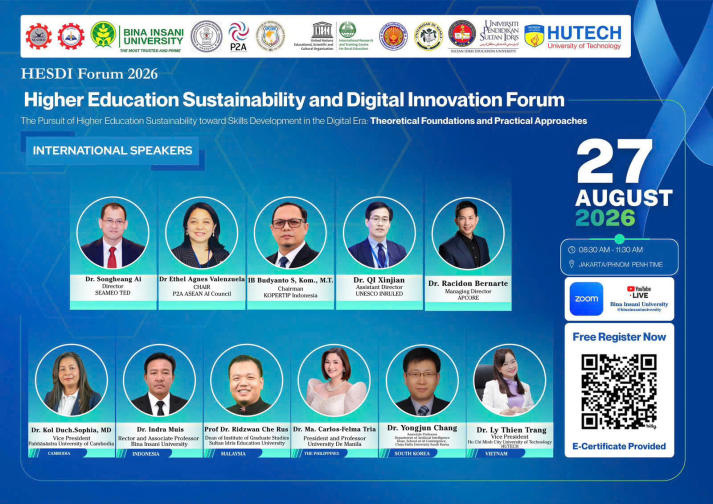
Her presentation, “Redefining Higher Education Sustainability in the Digital Era: Global Trends, Challenges, and Opportunities,” approached sustainability from multiple dimensions, encompassing environmental considerations, people, technology, educational quality, global responsibility, and adaptability to change. Against the backdrop of AI, digital transformation, changing skills demands, the green transition, and global uncertainties, she highlighted the importance of preparing future-ready learners with digital, green, human, and global competencies.
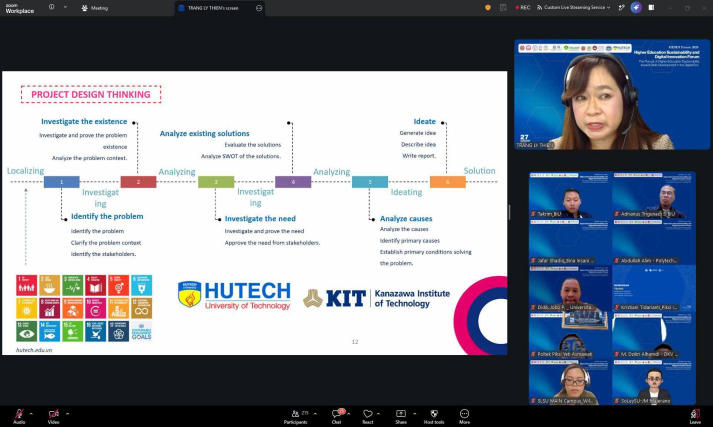
Dr. Ly Thien Trang shares HUTECH’s perspectives on higher education sustainability at HESDI Forum 2026
The forum, co-hosted by HUTECH and international partners, brought together more than 200 experts, higher education leaders, and scholars from several countries, creating a space for exchanging perspectives on digital transformation, AI, sustainable university governance, skills development, and university-industry-community collaboration.
Dr. Ly Thien Trang continued to contribute HUTECH's institutional experience at an international webinar organized by the ASEAN Quality Assurance Association, which gathered approximately 170 higher education leaders, administrators, faculty members, and experts from eight ASEAN countries.
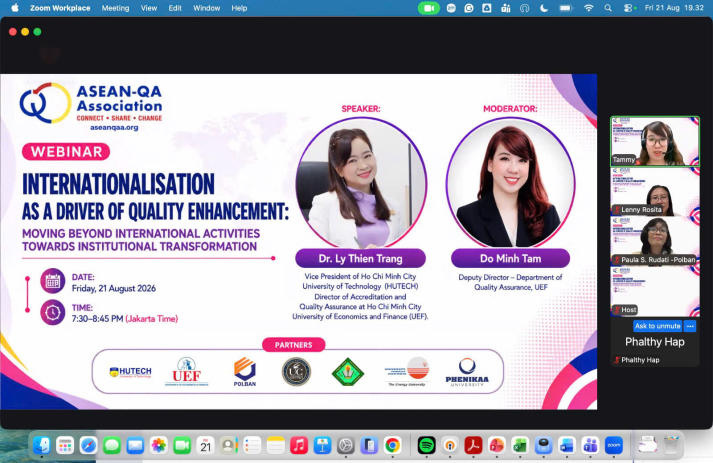
Addressing the relationship between internationalization and quality enhancement, she proposed moving from an “international ecosystem” toward a “quality ecosystem,” where international cooperation, student and faculty mobility, research, accreditation, rankings, and sustainable development are connected with education and training.
Rather than measuring internationalization primarily through the number of agreements, exchanges, projects, or other activities, the approach emphasizes the changes these activities create within an institution. These may include improvements in curricula and teaching methods, stronger research and quality assurance capacity, enhanced international competencies among faculty and staff, broader global perspectives among students, and improvements in university governance.
The presentation also highlighted opportunities to make international experiences accessible to more students through Collaborative Online International Learning (COIL), virtual exchanges, multicultural classrooms, international faculty, and international projects.
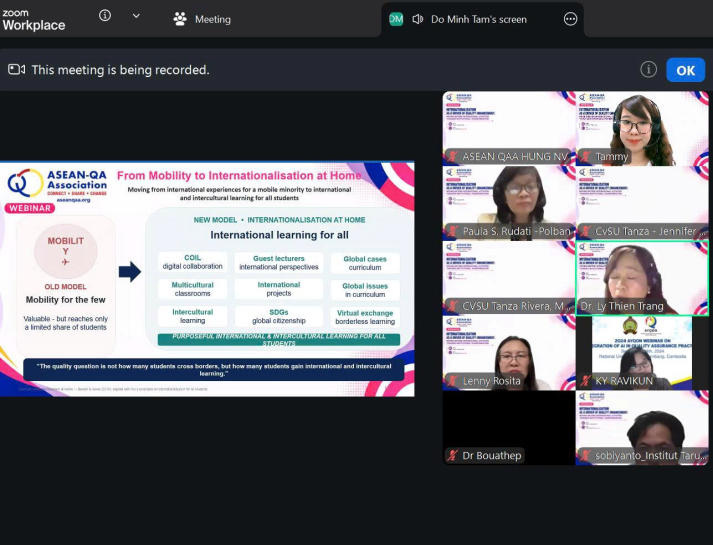
Dr. Ly Thien Trang discusses internationalization as a driver of quality enhancement at the ASEAN-QA Association webinar
Connecting university knowledge with business innovation
HUTECH's expertise was also shared beyond traditional higher education forums. At a training program on innovation for startups and small and medium enterprises in Ho Chi Minh City, Mr. Nguyen Xuan Hung, Director of HUTECH's Vietnam-Japan Institute of Technology (VJIT), introduced a university-business co-creation model based on HUTECH's experience in innovation and entrepreneurship education.
His presentation, “Co-creating with businesses: Methods to develop innovative solutions from the university startup ecosystem,” positioned universities as important sources of knowledge, research, young talent, and experimentation within the innovation ecosystem.
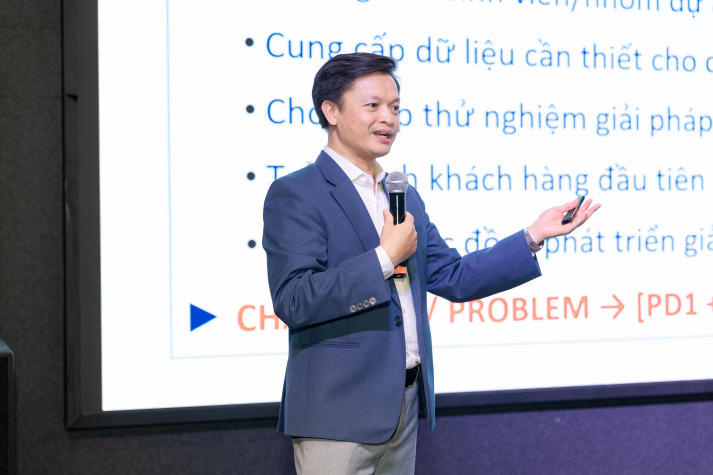
The model connects these resources with real business needs: businesses contribute practical problems, data, and testing conditions, while universities bring together students, lecturers, experts, research resources, and startups to jointly develop solutions. Businesses can subsequently participate as first customers, investors, or co-development partners, helping promising solutions move closer to the market.
Drawing from HUTECH's practices, Mr. Nguyen Xuan Hung also shared approaches involving project design thinking, innovation methods, entrepreneurial mindset, and project-based learning, through which students learn to identify problems, understand needs, develop solutions, and create value.
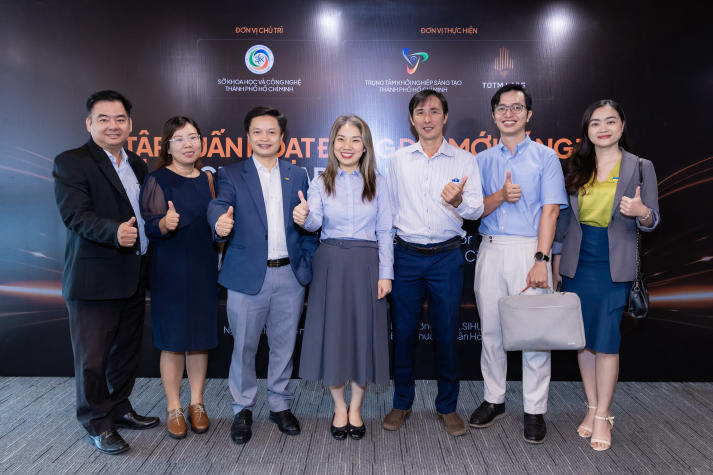
Mr. Nguyen Xuan Hung presents HUTECH’s university-business co-creation approach to the startup and SME community
Sharing practical approaches to outcome-based education
In another academic setting, representatives of HUTECH's Faculty of Korean Studies contributed their experience in connecting educational outcomes with the changing needs of society at the KF Friends Networking 2026 International Conference in Da Nang.
In another academic setting, representatives of HUTECH's Faculty of Korean Studies contributed their experience in connecting educational outcomes with the changing needs of society at the KF Friends Networking 2026 International Conference in Da Nang.
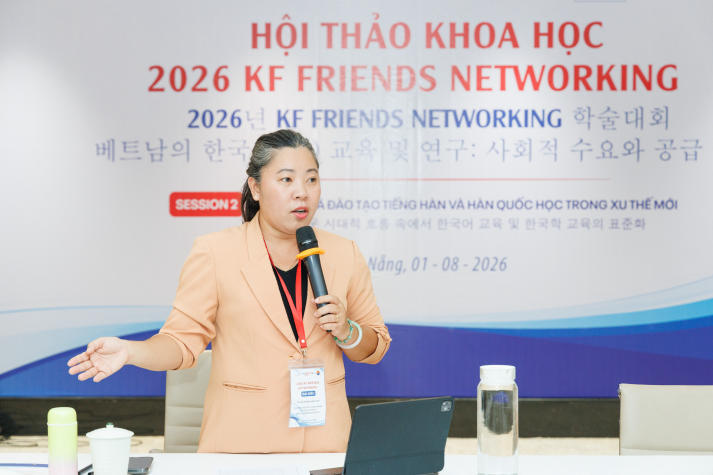
Dr. Bui Phan Anh Thu, Dean of the Faculty of Korean Studies, and Ms. Tran Le Thuy Van, Head of the Korean Language Department, presented “Connecting Social Needs with Learning Outcomes of the Korean Language Program at HUTECH”
Their presentation introduced an integrated learning ecosystem combining KF Global e-School, HUTECH's LMS system, digital resources, and international academic activities to translate program learning outcomes into practical student competencies. The approach combines in-person and online learning with activities that support the development of professional language proficiency, digital literacy, self-directed learning, intercultural communication, and international integration.
Beyond her role as a speaker, Dr. Bui Phan Anh Thu was invited to chair a scientific subcommittee, facilitating discussions on curriculum innovation, teaching methods, Vietnamese-Korean machine translation, and technology applications in Korean language education. The conference brought together the Korea Foundation, the Korean Research Association in Vietnam, and nearly 40 institutions offering Korean Language and Korean Studies programs nationwide.
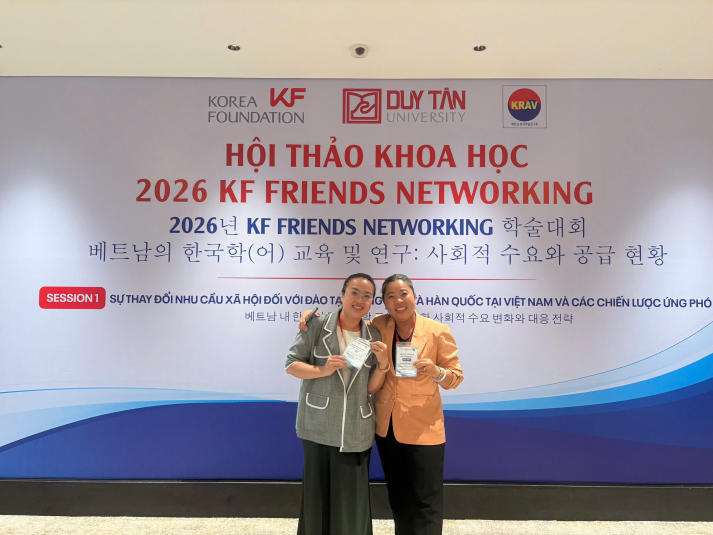
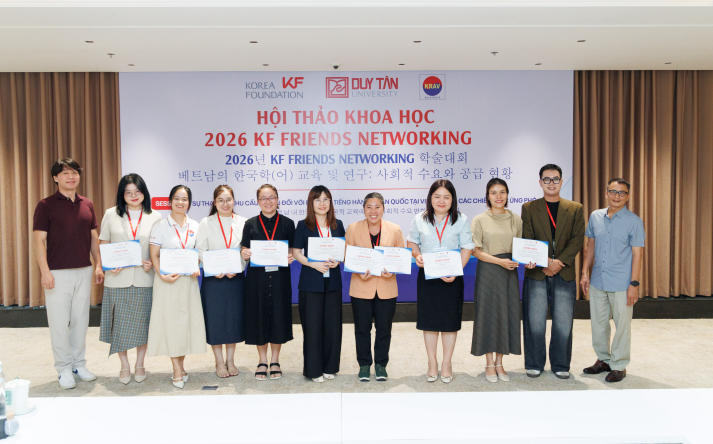
HUTECH representatives share their outcome-based approach to Korean Language education at KF Friends Networking 2026
From redefining sustainability and measuring the impact of internationalization to linking learning outcomes with social needs and connecting university resources with business innovation, HUTECH representatives contributed practical perspectives developed through the University's own educational, research, internationalization, and industry engagement activities.
Their participation as speakers and academic contributors also creates opportunities for two-way exchange. By sharing HUTECH's practices while engaging with perspectives from other universities, education networks, experts, and businesses, these forums support the continued exchange of knowledge and the development of academic and professional connections within Vietnam and internationally.
Department of International Relations and Project Management
Department of International Relations and Project Management
Các tin khác
HUTECH Students Make Their Mark at National and International Academic Competitions
From June to August 2026, HUTECH students continued to demonstrate their academic abilities, language proficiency, and global competencies through...
HUTECH to Host DAAD-funded “From Exchange to Impact” Workshop on Quality Assurance for Sustainable Higher Education
On October 6, 2026, Ho Chi Minh City University of Technology (HUTECH) and the University of Economics and Finance Ho Chi Minh City (UEF) will...
HUTECH faculty strengthen professional capacity through international learning
From research and educational leadership to internationalization and innovative teaching, HUTECH faculty continued to strengthen their professional...
HUTECH expands its multidisciplinary ecosystem with new academic and research hubs
In 2026, HUTECH continued to expand its multidisciplinary academic ecosystem through a series of significant developments in health sciences,...
From shared practices to climate action: HUTECH advances its sustainability journey
With sustainability becoming an increasingly important priority in higher education, HUTECH has continued to strengthen its institutional approach...
Thông tin mới
-
CALL FOR NOMINATION - SPRING 2027 SEMESTER EXCHANGE AT HUTECH

-
[Invitation & Call for Papers] The 1st TU–HUTECH Joint International Research Network QS Forum 2026
-
HUTECH Students Make Their Mark at National and International Academic Competitions
-
HUTECH to Host DAAD-funded “From Exchange to Impact” Workshop on Quality Assurance for Sustainable Higher Education
-
HUTECH faculty strengthen professional capacity through international learning
-
HUTECH shares academic expertise across regional and professional forums