


HUTECH and Asahi Engineering launch phase 3 of joint research project on easy rigid-frame bridges (ERB)
- 28/07/2025
On July 25, the Vietnam - Japan Institute of Technology (VJIT) at Ho Chi Minh City University of Technology (HUTECH) held a working session with Asahi Engineering Co., Ltd. (Japan). The session marked the official launch of Phase 3 in the HUTECH - Asahi joint research project.
The delegation from Asahi Engineering Co., Ltd. included Mr. Tokuno Mitsuhiro - Chairman of the Board; Mr. Nakai Yoshiaki - Executive Director and Head of the partner research team; Mr. Akiyama - Head of Sales Department; Mr. Hashimoto - Staff member from the Design Department; and Ms. Truong Thi Thanh - Staff member from the General Affairs Department.
The delegation from Asahi Engineering Co., Ltd. included Mr. Tokuno Mitsuhiro - Chairman of the Board; Mr. Nakai Yoshiaki - Executive Director and Head of the partner research team; Mr. Akiyama - Head of Sales Department; Mr. Hashimoto - Staff member from the Design Department; and Ms. Truong Thi Thanh - Staff member from the General Affairs Department.
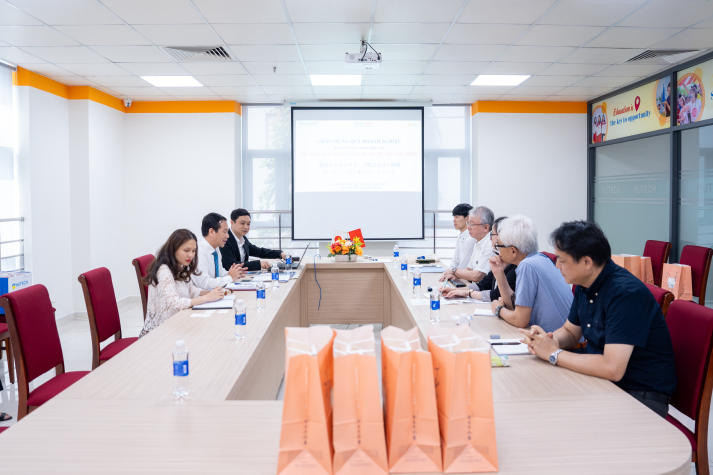
The working session marks the official launch of phase 3 of the HUTECH - Asahi joint research project
Representing HUTECH were Prof. Dr. Le Van Canh - Vice President; Dr. Ha Minh Tuan - Vice Director of VJIT and Head of the research team; and Dr. Hoang Ngoc Nhung - Deputy Head of the Department of International Relations and Project Management.
The HUTECH - Asahi research project focuses on the technology transfer of design and construction techniques for rigid-frame bridges in the Vietnamese market, and has been implemented since 2021. During the meeting, Dr. Ha Minh Tuan presented an overview of the project’s three phases. Phase 1, which has been completed, aimed to assess the applicability of rigid-frame bridges (ERB) in Vietnam and to adapt the design to Vietnamese standards. Currently, the research team is continuing with Phase 2 - Developing a Finite Element Model (FEM) to analyze the structure of an improved beam - and Phase 3, in which HUTECH is proposing a streamlined testing method titled “Experimental and simulation study on the flexural performance of H-shaped reinforced concrete composite beams with simplified compressive flange.”
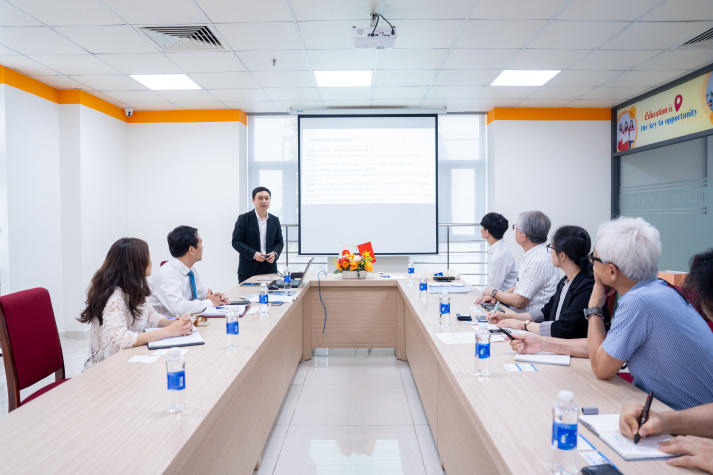
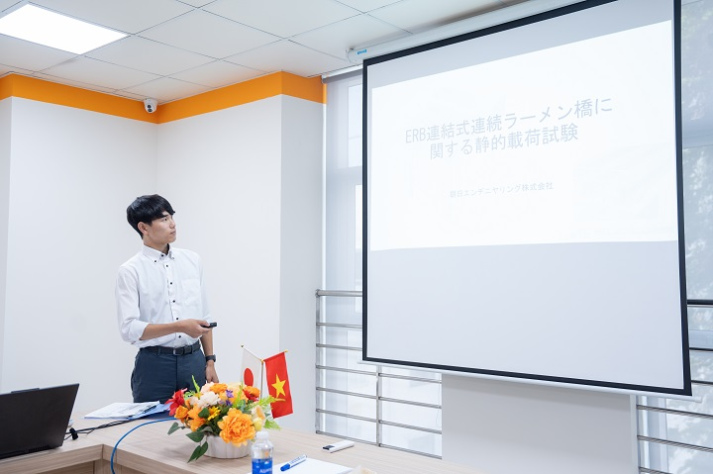
Project overview and Phase 3 research plan shared in detail during the working session
The experimental results are expected to confirm that the load-bearing capacity of beams with trimmed flanges is nearly equivalent to that of intact beams. At the same time, the streamlined approach aims to reduce complexity and cost, enabling quicker validation of core hypotheses before conducting full-scale experiments in Japan, as originally agreed.
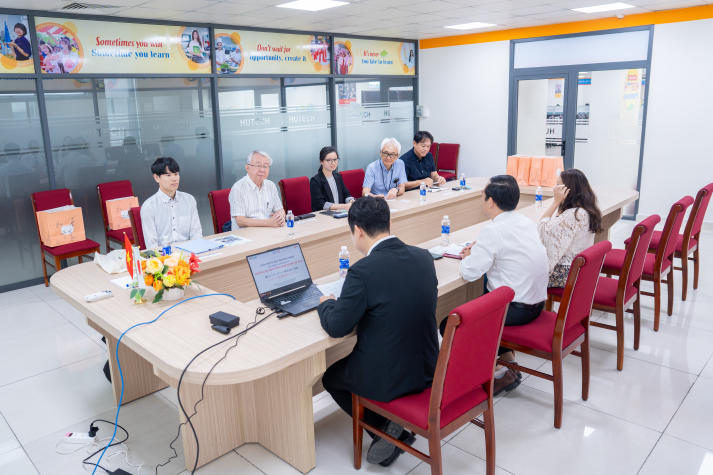
Key information on the research methodology was discussed during the session
Representatives from Asahi Engineering also noted that a key advantage of rigid-frame bridges is their ease of construction, which allows local contractors to execute the work while maintaining quality and ensuring low maintenance costs. The company emphasized its commitment to continuing research on design and construction processes that suit Vietnam’s terrain, while also addressing challenges such as curvature in fabrication and exploring the use of T-shaped steel sections.
Both sides reached a high level of consensus and officially approved the streamlined research plan for Phase 3 proposed by HUTECH. The project is scheduled to be implemented from June 2025 to March 2027 under the terms of the signed agreement. A research grant of 1,000,000 Japanese Yen will be provided by the partner to support HUTECH’s research activities.
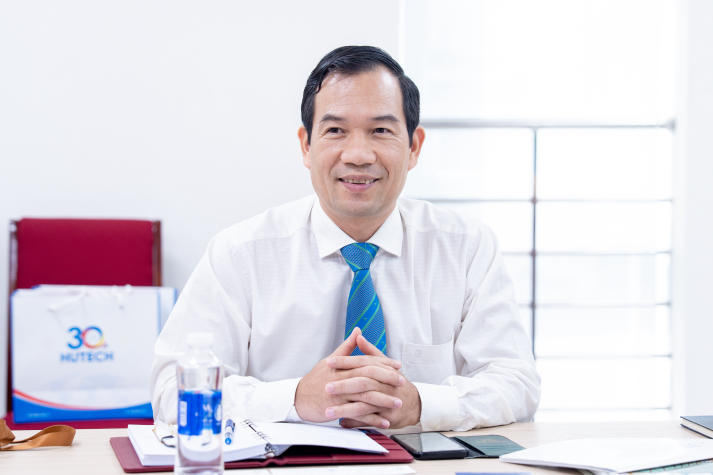
Prof. Dr. Le Van Canh reaffirms HUTECH’s full support to maximize research outcomes
Speaking at the meeting, Prof. Dr. Le Van Canh emphasized that HUTECH is fully committed to supporting the project to ensure the best possible outcomes. He also noted that rigid-frame bridges are well-suited to Vietnam’s local conditions and could be effectively applied, especially in the Mekong Delta region. However, further research is still needed to optimize cost and ensure high-quality construction.
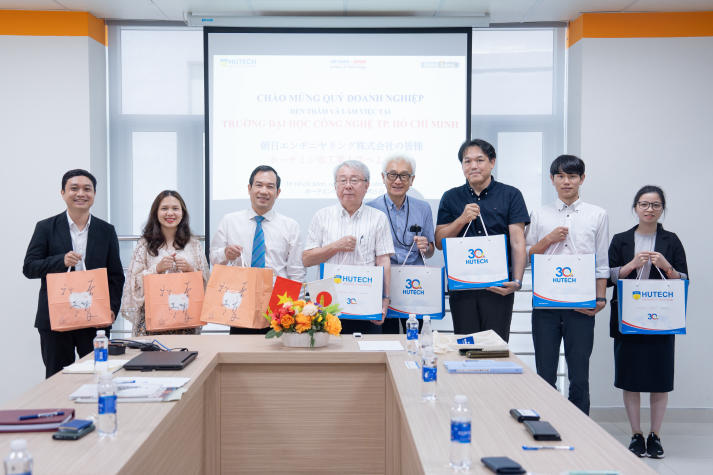
The project aims to deliver a modern rigid-frame bridge solution adapted to Vietnam’s conditions
The HUTECH - Asahi project is expected to offer a modern rigid-frame bridge solution tailored to Vietnam’s context. With HUTECH’s dedicated involvement and the research team’s serious commitment, the project will contribute to sustainable transportation development solutions.
Communication Center
Communication Center
Other news
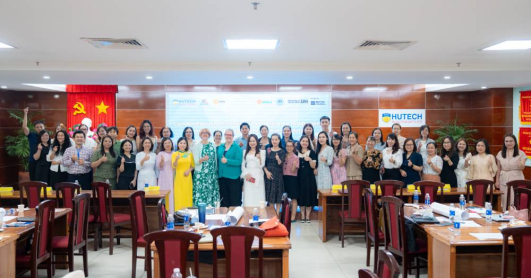
MOOC on “Women and Leadership” to launch on July 20
Aiming to promote gender equality and enhance leadership capacity among female staff, lecturers, and educators in academic institutions, the...
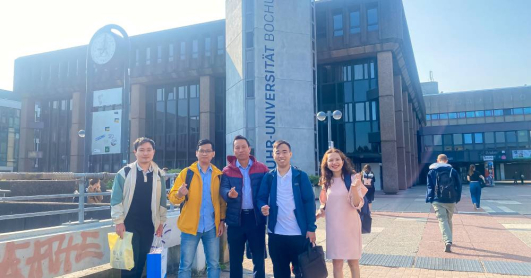
HUTECH delegation visits Germany to strengthen research collaboration with Ruhr-Universität Bochum
As part of a collaborative research project funded by the Alexander von Humboldt Foundation, one of the most prestigious scientific funding...
Gender Equality Partnership Programme: Addressing women’s underrepresentation in leadership
Gender Equality Partnership Programme: Addressing women’s underrepresentation in leadership is a significant initiative sponsored by British Council.
EmpowerTNE: Enhancing UK TNE value in Vietnam
Transnational Education Development Project (EmpowerTNE: Enhancing UK TNE value in Vietnam) – a key initiative funded by the British Council.
HUTECH and Ruhr-Universität Bochum (Germany) receive prestigious research grant from the Humboldt Foundation
Ho Chi Minh City University of Technology (HUTECH) has marked a significant milestone in international collaboration and research by receiving a...
EVENT Project
The EVENT project is one of the key initiatives under the European Union (EU)'s flagship program, funded by the Erasmus+ program.