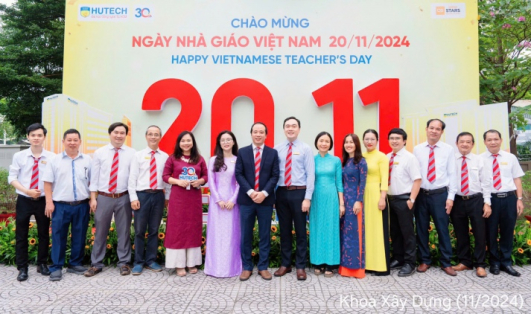
I. INTRODUCTION
1. OVERVIEW
HUTECH was established in 1995. It was also the year when the Faculty of foreign Languages was established and the English language (EL) programme was launched. The Faculty’s current name “Faculty of English Language” was later adopted in September 2017.
2. MISSION
Based on the mission of HUTECH, the mission of the FoEL is to strive for excellence in training high quality human resources for national development through services such as education, training and scientific research. In addition, it always tries to build up a dynamic and creative study environment in order to optimize the individual potentials. It pledges to be the pioneer in providing high-quality human resources in the field of English language, and in training learners to have specialized knowledge along with professional practical skills, to possess good political qualities, to have the ability to follow lifelong learning, be self-dependent, work independently as well as creatively, and to adapt well in the knowledge economy.
FoEL will become one of the leading and prestigious faculties that train and produce Bachelors of Arts in English Language in the country. It will strive to become an academic training centre for high quality human resources for national, regional and international work environments by 2030.
3. CORE VALUES
4. LEADERSHIP
The organization of FoEL
CONTACT
Address: A-04.10 - 475A Dien Bien Phu Street, Thanh My Tay Ward, Ho Chi Minh City, Vietnam.
Phone: 0817 337 151
Email: khoa.ta@hutech.edu.vn
Website: Faculty of English Language – Khoa Tiếng Anh
5. STUDY PROGRAMMES
The Faculty of English Language (FoEL) is one of the leading English-language-education faculties in Ho Chi Minh City and in the South of Vietnam. The design of the Bachelor of Arts in English Language (EL) Program was compiled with Vietnamese Higher Education Law and the Vietnamese Qualifications Framework stipulated by the Vietnam Ministry of Education and Training (MoET) together with regulations and guidelines of Ho Chi Minh City University of Technology (HUTECH). It is ensured that the EL program covers its goals and objectives, expected learning outcomes (ELOs) including knowledge, skills, and attitudes and responsibility, and that the ELOs are in alignment with the mission and vision of HUTECH and FoEL.
The EL program was first launched in 1995, right in the year when the faculty was established. The general goals of the EL program are:
To train workforce, enhance people’s cultural and intellectual standards, do scientific research, meet the demand of socioeconomic development, and ensure the national security and integration of the country; and
To produce workforces in the field of English language with good political and moral qualities, good health, high English proficiency for effective communication, solid professional knowledge and skills in translation and interpretation, or in teaching English at schools or language centres, or using English in other fields of work as well as competence in individual and collaborative work, and high sense of commitment to community in response to the increasing demands for socio-economic development of the locality and the country.
With the increasing demand for high quality workforces to meet the requirements of socio-economic development and global integration of the country, the EL program of HUTECH was introduced to provide society with English teachers, interpreters, translators, and English practitioners in different fields. Throughout the course of over 30 years of training from 4/1995-7/2021, more than 8,000 English-majored students have graduated from HUTECH. These graduates are now holding important positions in different international and local enterprises and organizations.
Graduates from the FoEL may look for jobs in different fields and or continue their further education. They will be able to: a) work as translators and interpreters at representative offices for international organizations, governmental and non-governmental organizations, in diplomatic agencies, international cooperation departments, journalism and communication agencies in Vietnam or in the region. b) work as secretaries, office coordinators or assistants, sales or import or export staff in state-owned or private enterprises. c) work as tour guides, receptionists in travel agencies, hotels or companies. d) work as teachers or teaching assistants for language centres and schools in Vietnam. e) lecture and conduct research in the areas of the English language, English language teaching at schools and colleges or universities. f) pursue postgraduate study in the English language and English language teaching and contrastive linguistics.
II. ADMISSION INFORMATION
Bachelor’s Degree: Click here for more information
Master’s Degree: Click here for more information
1. PROGRAM OVERVIEW
The program aims to train graduates in the English Language major who possess good political and ethical qualities, sound health, a foundational knowledge of culture, social and natural sciences, IT skills, and proficiency in a second foreign language. Graduates will have a high level of English proficiency for effective communication in various contexts, specialized knowledge and skills, and soft skills to adapt to the challenging work environment of the Industry 4.0 era. The program is designed to meet the country’s socio-economic development and international integration needs.
The English Language bachelor's program aims to produce graduates who:
PO1: Possess knowledge of culture, social and natural sciences, politics, law, and language; are proficient in using a second foreign language and IT to apply in various contexts to meet life and job demands.
PO2: Possess in-depth knowledge of the English language and can proficiently use the four English skills at Level 5 of the Vietnamese Foreign Language Proficiency Framework for communication and professional contexts.
PO3: Possess professional knowledge and skills in areas such as commerce, translation and interpretation, English teaching methodology, tourism, hospitality, and the ability to apply this knowledge in the workplace.
PO4: Demonstrate the ability to work independently, creatively, and responsibly; possess communication skills to adapt to challenging work environments; and always adhere to ethical standards in both life and work.
1.3. Study Environment
The English Language program at HUTECH offers a modern, dynamic, and internationally-oriented study environment. Students learn in well-equipped classrooms and language labs with advanced audio-visual systems that support the development of all four core skills: listening, speaking, reading, and writing. A team of experienced, highly qualified, and dedicated lecturers is always ready to guide and support students throughout their academic journey.
In addition to formal classes, students have opportunities to join academic clubs, workshops, and seminars led by native speakers and international experts. These activities help enhance practical English skills and foster confidence in real-world communication. The open and diverse learning environment at HUTECH encourages creativity, critical thinking, and active participation, preparing students to thrive in a globalized world.
2. PROGRAMME DESCRIPTION
3. PROGRAM LEARNING OUTCOMES
4. LIST OF COURSES
First year
Semester 1
Semester 2
Elective Knowledge:
Group 1:
06 | PHT304 | Volleyball 1
Group 2:
06 | PHT307 | Basketball 1
Group 3:
06 | PHT310 | Fitness and Aesthetics 1
Group 4:
06 | PHT313 | Vovinam 1
Group 5:
06 | PHT316 | Football 1
Semester 3
Second year
Semester 4
Elective Knowledge:
Group 1:
07 | PHT305 | Volleyball 2
Group 2:
07 | PHT308 | Basketball 2
Group 3:
07 | PHT311 | Fitness and Aesthetics 2
Group 4:
07 | PHT314 | Vovinam 2
Group 5:
07 | PHT317 | Football 2
Semester 5
Elective Knowledge:
Group 1:
07 | PHT306 | Volleyball 3
Group 2:
07 | PHT309 | Basketball 3
Group 3:
07 | PHT312 | Fitness and Aesthetics 3
Group 4:
07 | PHT315 | Vovinam 3
Group 5:
07 | PHT318 | Football 3
Semester 6
Third year
Semester 7
Semester 8
Semester 9
Fourth year
Semester 10
Specialization Group 1: English for Business
| 03 | ENG197 | Fundamental of marketing |
| 04 | ENG198 | Business communication skills |
| 05 | ENG199 | Principles of Business Management |
| 06 | MAN2053 | Office administration |
Specialization Group 2: English Translation and Interpretation
| 03 | ENG1001 | Translation Theory |
| 04 | ENG1006 | Technology in Translation and Interpretation |
| 05 | ENG1002 | News Translation |
| 06 | ENG156 | Advanced Interpretation |
Specialization Group 3: English Language Teaching Methods
| 03 | ENG172 | English Language Teaching Theories |
| 04 | ENG173 | English Language Teaching Techniques |
| 05 | ENG175 | Teaching English to Children |
| 06 | ENG174 | English Teaching Practicum |
Specialization Group 4: English for Tourism, Hospitality, and Restaurant Industry
| 03 | ENG1003 | Overview of Tourism, Hospitality, and Restaurants |
| 04 | ENG129 | Tour Guiding Skills |
| 05 | ENG1004 | Hotel Reception Operations |
| 06 | ENG1005 | Tourism, Hospitality, and Restaurant Marketing |
Specialization Group 5: Graduation Thesis
| 07 | ENG477 | Graduation Thesis in English Language |
Semester 11
5. TEACHING & LEARNING STRATEGIES AND METHODS
6. ASSESSMENT
7. ACADEMIC REGULATIONS
8. ACCESS TO EBOOKS AND OPEN ACCESS RESOURCES AT THE LIBRARY
Click here for more information
9. CAREER OPPORTUNITIES


IV. MASTER OF ENGLISH LANGUAGE
1. PROGRAM OVERVIEW
1.1 Program Goal
1.2 Program Objectives
These objectives embrace in-depth theoretical and practical expertise in English language studies which will be beneficial to graduate students after finishing the Master’s program of English Language at HUTECH. Not only do they accumulate the knowledge of the English language, they will be able to apply the theories they have learned into their work and to formulate their own philosophy in their life. Knowledge in doing research, both qualitative and qualitative will enable them to give evidenced-based decisions being in line with the dynamic socio-economic environment. In addition, graduate students are hopefully able to exhibit leadership, ethical standards, social responsibility and the ability to work in interdisciplinary and multicultural teams. Their commitment to lifelong learning and adaptability to global trends ensures their capacity to contribute to sustainable development of society.
1.3 Study Environment
The Master’s program of English Language at HUTECH offers a modern, application-oriented, and internationally integrated learning environment that fosters learners’ comprehensive development in both academic knowledge and professional competencies.
3.1. Modern Facilities
Learners attend classes in well-equipped rooms featuring projectors, audio systems, and air conditioning. Multimedia laboratory is well equipped and the school library which houses various sources of both printed and on-line materials in English as well as textbooks of all the subjects taught in the program are available.
3.2. Digital Learning Platforms
The program is supported by a digital ecosystem, including HUTECH’s Learning Management System (LMS), the e-HUTECH portal, and the Edusoft training management system—allowing students to manage their schedules, access materials, and track academic performance anytime, anywhere.
3.3. Academic and Research
Resources HUTECH provides a modern library system with thousands of printed books and digital resources, including access to national and international databases, supporting learners in both coursework and academic research.
3.4. Industry-Based and Practical Learning
The curriculum integrates research activities, thematic discussions, academic seminars, and field trips to educational institutions both in Ho Chi Minh City and abroad. These activities help learners apply knowledge in real-world settings while expanding their professional networks.
3.5. Active Academic Environment
Beyond the classroom, learners are encouraged to join academic clubs, expert talks, training workshops, and scientific conferences organized by the Institute of Postgraduate Studies and the university. These activities promote creativity, critical thinking, and collaboration in a dynamic educational space.


2. PROGRAMME DESCRIPTION
3. AREAS OF FOCUS
English Language and Culture
Teaching English
Translation Studies
4. PROGRAMME LEARNING OUTCOMES
5. LIST OF COURSES
6. TEACHING & LEARNING STRATEGIES AND METHODS
At HUTECH, our teaching and learning methods are based on international best practice to ensure that learners enter the workplace with the knowledge skills they need to succeed in both national and international working environments.
6.1 Teaching & Learning Strategies
We are committed to providing learners diverse and student-centered teaching and learning approach aligned with HUTECH educational philosophy:
“Learn to learn – Learn to do – Learn to create – Learn to be independent – Learn to develop together” These strategies aim to foster active engagement, independent inquiry, problem-solving skills, and reflective thinking among learners. The main strategies include:
Direct instruction with interactive lectures and practice
Indirect instruction with case study
Experiential learning with simulation and role play
Interactive instruction with brainstorming, discussion, oral presentation, seminar, debate, journal writing or reflection and peer evaluation review
Independent study with written assignments and project
6.2 Teaching & Learning Methods
A wide range of methods are employed to ensure the development of practical competencies and adaptability to the dynamic tourism and travel industry:
Flipped learning
Problem-based learning
Project-based learning
Blended learning
Experiential learning
Reflection and self-assessment
Debate, demonstration, and simulation
Technology-enhanced learning (e.g., AI applications, gamification, etc.)
Learners’ experience includes classroom learning, facilitated online and self-directed learning through Learning Management System (LMS), peer learning, industry field trips and guest speakers.
These strategies and methods are integrated throughout the curriculum via key modules such as: Research Methodology, Seminar on English Language Studies, Teaching Translation and Interpreting, Cross-cultural Perspectives in Language Teaching as well as through projects and research assignments.
They enable students to develop critical thinking, research capability in English language, creativity in teaching English, teamwork open to novelty—consistent with HUTECH’s focus on applied, industry-relevant, and internationally integrated education.
7. ASSESSMENT
The Master’s program of English Language at HUTECH applies a comprehensive, outcome-based assessment system to evaluate learners’ mastery of the programme learning outcomes (PLOs). This system integrates both formative and summative assessments designed to align with Bloom’s Taxonomy and measure a wide range of cognitive and practical competencies.
7.1. Assessment Methods
A variety of assessment methods are used to be constructively aligned to achieving the program learning outcomes and course learning outcomes as well as the teaching and learning objectives. They include:
Individual and group assignments
Presentations and essays
Case study analyses
Exams and quizzes
Projects and research theses
Practicum reports
7.2. Assessment Tools & Rubrics
The assessment methods are used to include rubrics, marking schemes, timelines, and regulations, and these are shown to ensure validity, reliability, and fairness in assessment. The assessment standards and procedures for student progression and degree completion and assessment-appeal policies are communicated to learners, and applied consistently.
Rubrics are developed for each task, clearly outlining performance criteria for transparency and objectivity.
Specific rubrics are used for various types of assessment, including attendance, group work, oral exams, practical performance, and thesis evaluation.
Technology-Enabled Assessment Monitoring:
Excel-Based Measurement System is used to track the attainment of Course Learning Outcomes (CLOs) and their contribution to PLOs.
A Smart OBE (Outcome-Based Education) system is being developed via LMS to automatically measure and report learner achievement in real time.
7.3. Consistency and Improvement
Assessments are regularly reviewed and updated to ensure alignment with industry needs and learning outcomes.
Stakeholder feedback and internal evaluations are used to refine the assessment system continuously.
8. ACADEMIC REGULATIONS
To effectively support your learning and research, the HUTECH Library has updated the following useful links:
📩 For further inquiries, please contact:
Website: https://lib.hutech.edu.vn
Email: tt.thuvien@hutech.edu.vn
9. CAREER OPPORTUNITY
9.1.
Roles Manager or executive in travel agencies, tour operators, hotels, or resorts
Department head in areas such as tour operations, product development, or MICE (Meetings, Incentives, Conferences, and Exhibitions)
Tourism development officer in businesses or tourism organizations
9.2. Consulting – Research – Education
Consultant in tourism product and destination development
Lecturer or researcher in tourism, travel, or hospitality management at universities, colleges, or research institutes
Contributor to tourism policy development in governmental agencies
9.3. Employment in Government or International Organizations
Project coordinator or program officer at NGOs or international organizations involved in tourism and cultural development
 |
 |
More information to visit at: Click here for more information
V. ACTIVITIES
Innovative English Teaching Solutions Proposed in Master’s Theses at HUTECH 18/06/2025
English students break stereotypes, improve their critical thinking with modern American literature
Creative Impact at Learning Express 2025: An International Collaboration to Shape the Future
Exploring to empathize: HUTECH and SP students engage with communities through LeX 2025
Creative Perspectives in English Teaching Research at Master's Thesis Defenses 26/02/2025
CYSG 2025: An academic forum connecting young scientists, graduate students, and doctoral candidates
HUTECH equips graduate students and doctoral candidates with information resource utilization skills
HUTECH English Language Postgraduates Successfully Defend Master’s Theses 29/11/2024
VI. INTERNATIONALISATION
Promoting internationalisation by adopting best practices in governance, leadership, and management models within higher education institutions.
Facilitating internationalisation through the development of joint programmes, including articulation agreements and franchise collaboration models.
Conducting benchmarking exercises with curricula from regional and international universities to ensure global relevance and competitiveness.
Advancing internationalisation through collaborative education and research partnerships with universities worldwide.
Aligning with international accreditation standards such as QA Ratings, QS Asia Rankings, FIBAA, and AUN-QA to enhance global recognition.
Fostering internationalisation in the staff and student body to promote diversity and global engagement.
Integrating international perspectives into teaching and learning materials, including offering modules or programmes delivered in English language and other languages where applicable.
Supporting internationalisation through the establishment of short-term and long-term student exchange programmes.
Expanding the international network of academics and employers to enhance global engagement, opportunities and reputation.
Promoting international research collaboration to address global challenges and contribute to innovative solutions.
Collaborating on initiatives that address pressing global issues such as climate change, diversity, equity, and inclusion, in alignment with Sustainable Development Goals (SDGs).
VII. ADMISSION INFORMATION FOR INTERNATIONAL STUDENTS
Click here for more information