


HUTECH students make their mark at International Youth Talk Forum
- 07/07/2025
Recently, students from Ho Chi Minh City University of Technology (HUTECH) participated in the international academic forum “International Youth Talk” with many breakthrough ideas on sustainable architecture.
International Youth Talk is an international academic forum aimed at fostering exchange and enhancing knowledge among young people from various regions. The event was co-organized by SEAMEO TED, Guizhou Polytechnic of Construction, and Go Study Global Education as part of the China-ASEAN Technical and Vocational Education Cooperation Program (CATECP).
International Youth Talk is an international academic forum aimed at fostering exchange and enhancing knowledge among young people from various regions. The event was co-organized by SEAMEO TED, Guizhou Polytechnic of Construction, and Go Study Global Education as part of the China-ASEAN Technical and Vocational Education Cooperation Program (CATECP).
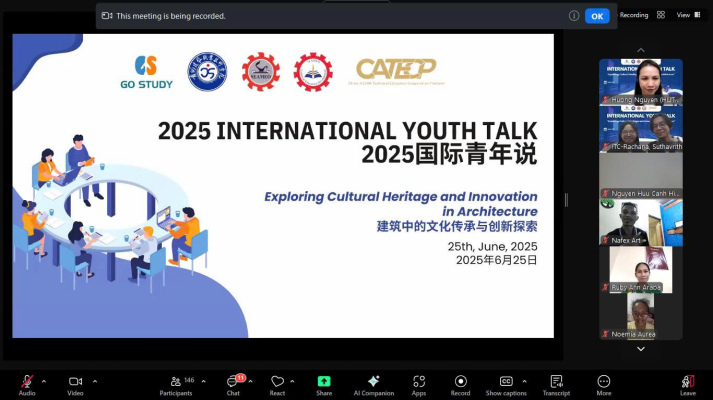
International Youth Talk serves as a platform to promote academic exchange among international youth
The first session of the program took place online on June 25. With the theme “Exploring cultural heritage and innovation in architecture,” the discussion brought together six student teams from China and ASEAN countries. Participating institutions included Guizhou Polytechnic of Construction (China), Institute of Technology of Cambodia (Cambodia), King Mongkut's Institute of Technology Ladkrabang (Thailand), National University of Laos (Laos), Politeknik Sultan Haji Ahmad Shah (Malaysia), and HUTECH (Vietnam). In 10-minute presentations in English, each team offered unique perspectives on their nation's cultural identity and architectural heritage.
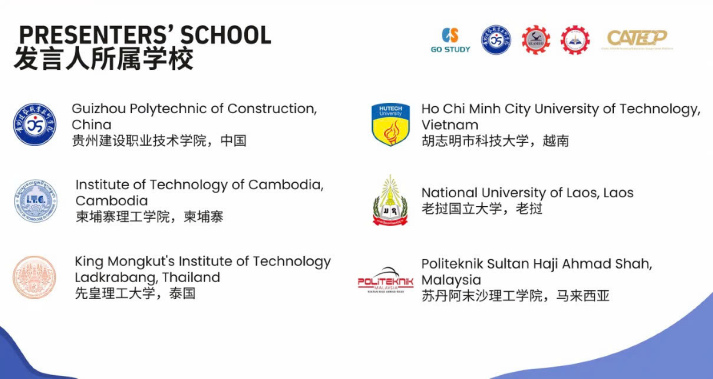
Session 1 was held online with the participation of six student teams from ASEAN countries and China
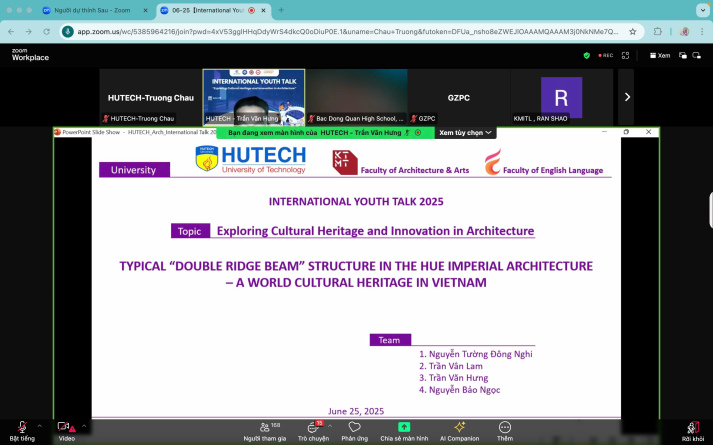
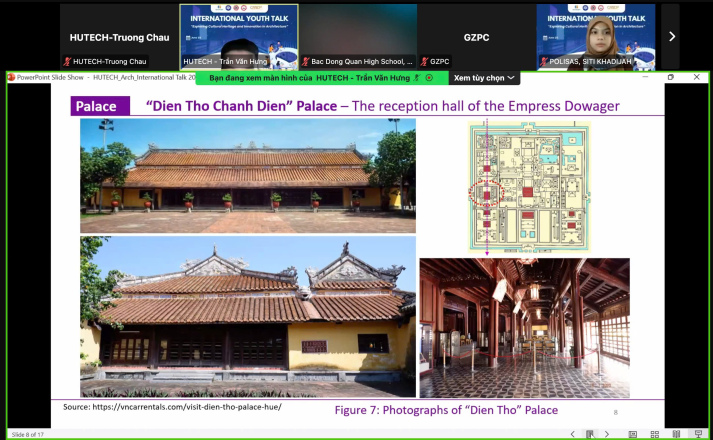
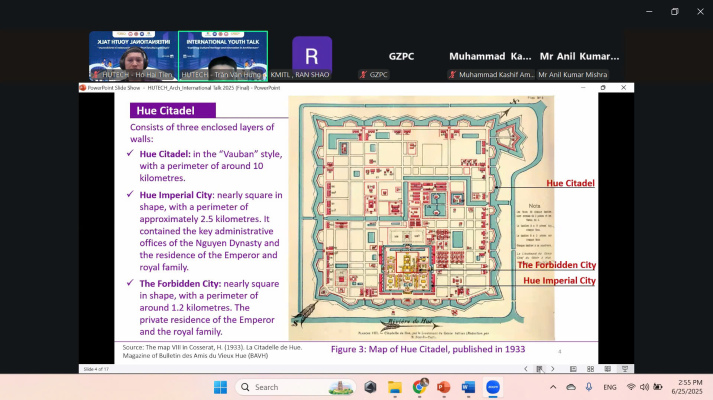
Representing HUTECH in the first session was a team of students including Nguyen Tuong Dong Nghi from class 22DKIA1 and Tran Van Lam from class 23DKIA1 of the Faculty of Architecture and Fine Arts; Tran Van Hung from class 22DTAB3 and Nguyen Bao Ngoc from class 23DTAB3 of the Faculty of English Language. The team presented the topic “Typical ‘double ridge beam’ structure in the Hue imperial architecture – A world cultural heritage in Vietnam.” Their presentation garnered strong interest and high praise thanks to thorough preparation under the guidance of Ms. Truong Ngoc Quynh Chau, an architecture and lecturer from the Faculty of Architecture and Fine Arts, and Mr. Ho Hai Tien from the Faculty of English Language.
Through their presentations, HUTECH students and peers from other universities shared their perspectives on cultural heritage and innovation in architecture. The exchanges highlighted the intersection between history, local identity, and modern design thinking. The forum also opened opportunities for collaboration and exploration of ways to preserve traditional values while embracing technology and sustainable development in architecture.
Through their presentations, HUTECH students and peers from other universities shared their perspectives on cultural heritage and innovation in architecture. The exchanges highlighted the intersection between history, local identity, and modern design thinking. The forum also opened opportunities for collaboration and exploration of ways to preserve traditional values while embracing technology and sustainable development in architecture.
 |
 |
 |
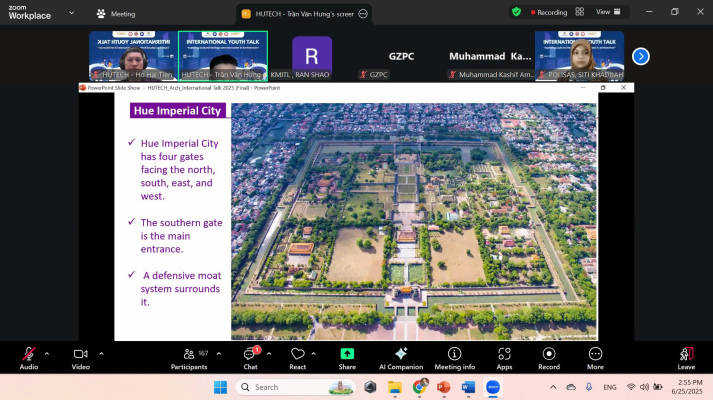 |
HUTECH students delivered a presentation in English on Hue imperial architecture – a world cultural heritage in Vietnam
Following that success, the second session took place on July 4, with the theme “Greener future: Sustainable cities and green architecture.” As cities around the world face unprecedented environmental challenges, student teams shared their ideas on how green architecture and eco-friendly urban planning can contribute to a more sustainable future.
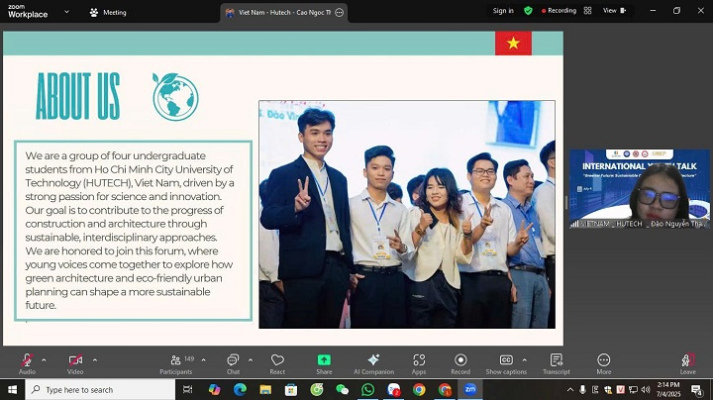
The HUTECH student team presenting in the second session included Cao Ngoc Thach and Dao Nguyen Thanh Binh from class 21DXDA1, Nguyen Tan Thanh from class 21DXDA2, and Nguyễn Văn Đoan from class 22DXDA2 of the Faculty of Civil Engineering. Accompanying the team were Dr. Ha Minh Tuan – Vice Director of the Vietnam-Japan Institute of Technology (VJIT), and Dr. Tran Tuan Nam – Deputy Head of the Faculty of Civil Engineering.
The HUTECH student team presenting in the second session included Cao Ngoc Thach and Dao Nguyen Thanh Binh from class 21DXDA1, Nguyen Tan Thanh from class 21DXDA2, and Nguyễn Văn Đoan from class 22DXDA2 of the Faculty of Civil Engineering. Accompanying the team were Dr. Ha Minh Tuan – Vice Director of the Vietnam-Japan Institute of Technology (VJIT), and Dr. Tran Tuan Nam – Deputy Head of the Faculty of Civil Engineering.
 |
 |
 |
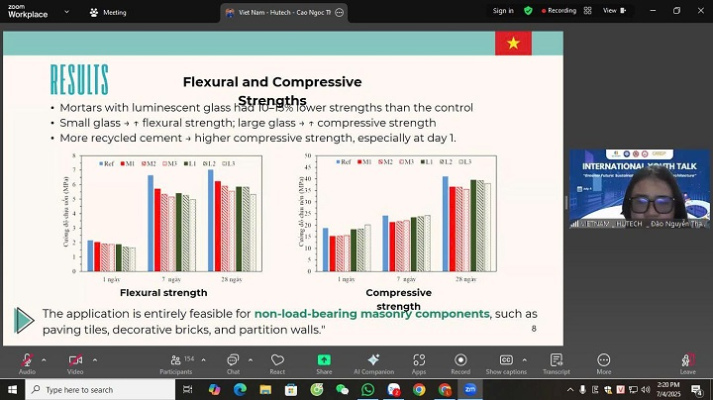 |
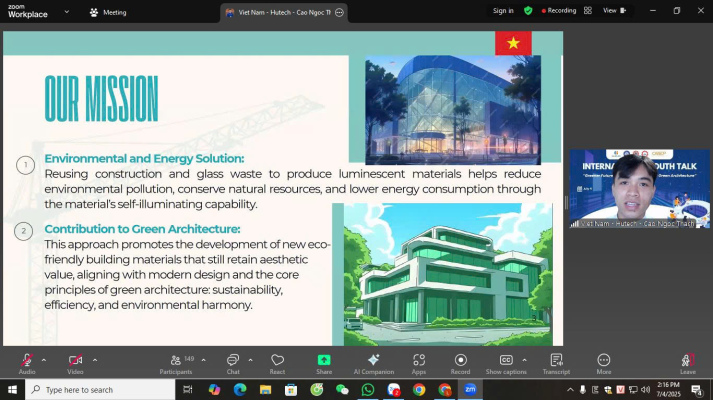
HUTECH students presented their research on reusing waste glass in construction materials
Their topic, “Effect of particle size of waste glass on mechanical and luminescent properties of mortars made of waste hydrated cement and luminescent waste glass,” contributed a new research direction on effectively reusing waste materials to support sustainable development in construction.
Through open and creative exchanges, the International Youth Talk forum inspired young people to envision green cities and sustainable growth. The active participation of HUTECH students was not only a chance for learning and cultural exchange but also a testament to their confidence and capacity for international integration. It further motivates students to maintain their proactive spirit and continue engaging in international exchange activities in the future.
News: Anh Hào
Communication Center
News: Anh Hào
Communication Center
Other news
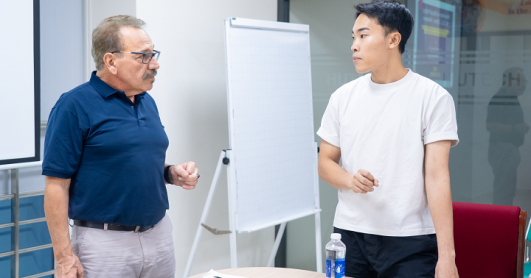
Business Administration students approach global economic policy with expert from Marquette University
To give students a better understanding of international business and the global economy, the Faculty of Business Administration at Ho Chi Minh...
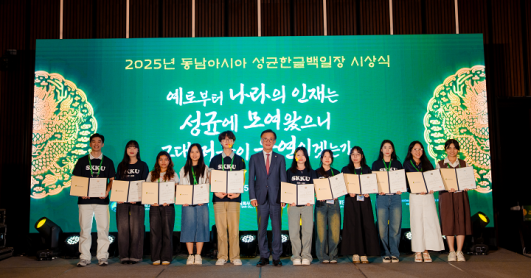
Korean Studies students excel at the 2025 Sungkyun Korean Essay Contest
Overcoming many competitors from universities across Vietnam and abroad, students from the Faculty of Korean Studies at Ho Chi Minh City University...
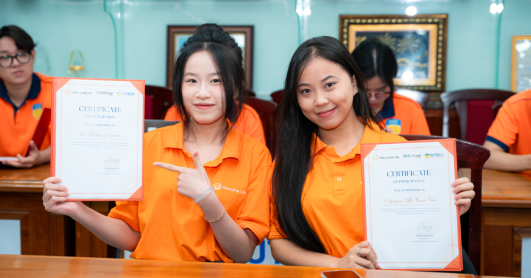
Hanwha Life Finance Mentor wraps up, highlighting growth of 40 HUTECH students
After more than a month of meaningful activities, 40 students from Ho Chi Minh City University of Technology (HUTECH) were honored on October 2 at...
“iHUTECH - iStart - iShine”: Freshmen connect through fun and teamwork
On the morning of October 1, the campus of Ho Chi Minh City University of Technology (HUTECH) came alive as the Institute of International...
HUTECH and Incheon students engage in Vietnam-Korea cultural exchange
On September 25, a group of students from Incheon (Korea), together with representatives from the Incheon Department of Education, joined the...
HUTECH and Korea Cyber University conclude educational exchange program
On September 23, the Faculty of Korean Studies at Ho Chi Minh City University of Technology (HUTECH) held a closing ceremony for the study tour and...